
AI Tools Helping Clinics Diagnose Faster: Why Multi-Specialty AI Platforms Matter
PRAID AI Team · Jan 12, 2026 · Max 12 min read
The Real Problem: Why Diagnosis Still Takes Too Long
The journey from symptom to diagnosis is often fragmented across disconnected clinical workflows: radiology imaging (X-rays, CT, MRI), pathology biopsies, manual reporting, and inter-departmental handoffs. This lack of shared context forces clinicians to act as manual integrators switching between systems, reconciling disparate reports, and coordinating across departments. These handoff bottlenecks not only add significant time to each case but also increase cognitive load and the risk of diagnostic error, ultimately delaying treatment decisions and impacting patient outcomes. For high-volume hospitals, solving these workflow fractures is the key to unlocking faster diagnosis. The challenges are multifaceted:- Cognitive overload: Clinicians are forced to switch between disparate systems, manually correlating imaging findings with pathology results, which increases mental fatigue and the risk of oversight.
- Handoff bottlenecks: Pathology reports often lag behind radiology outputs, creating delays in multi-disciplinary team meetings and final treatment decisions.
- Risk escalation: In overburdened facilities, these misalignments can heighten diagnostic errors, impacting patient safety and institutional credibility.
What Single-Modality AI Does Well and Where It Falls Short
Early-generation AI diagnostic tools have demonstrated remarkable proficiency within narrow domains:- Detecting lung nodules in chest X-rays with up to 95% accuracy in controlled trials.
- Highlighting malignant cells in digital pathology slides with high sensitivity.
- Prioritizing urgent cases in cardiology (ECG) or dermatology imaging.
What a Multi-Specialty AI Platform Really Means
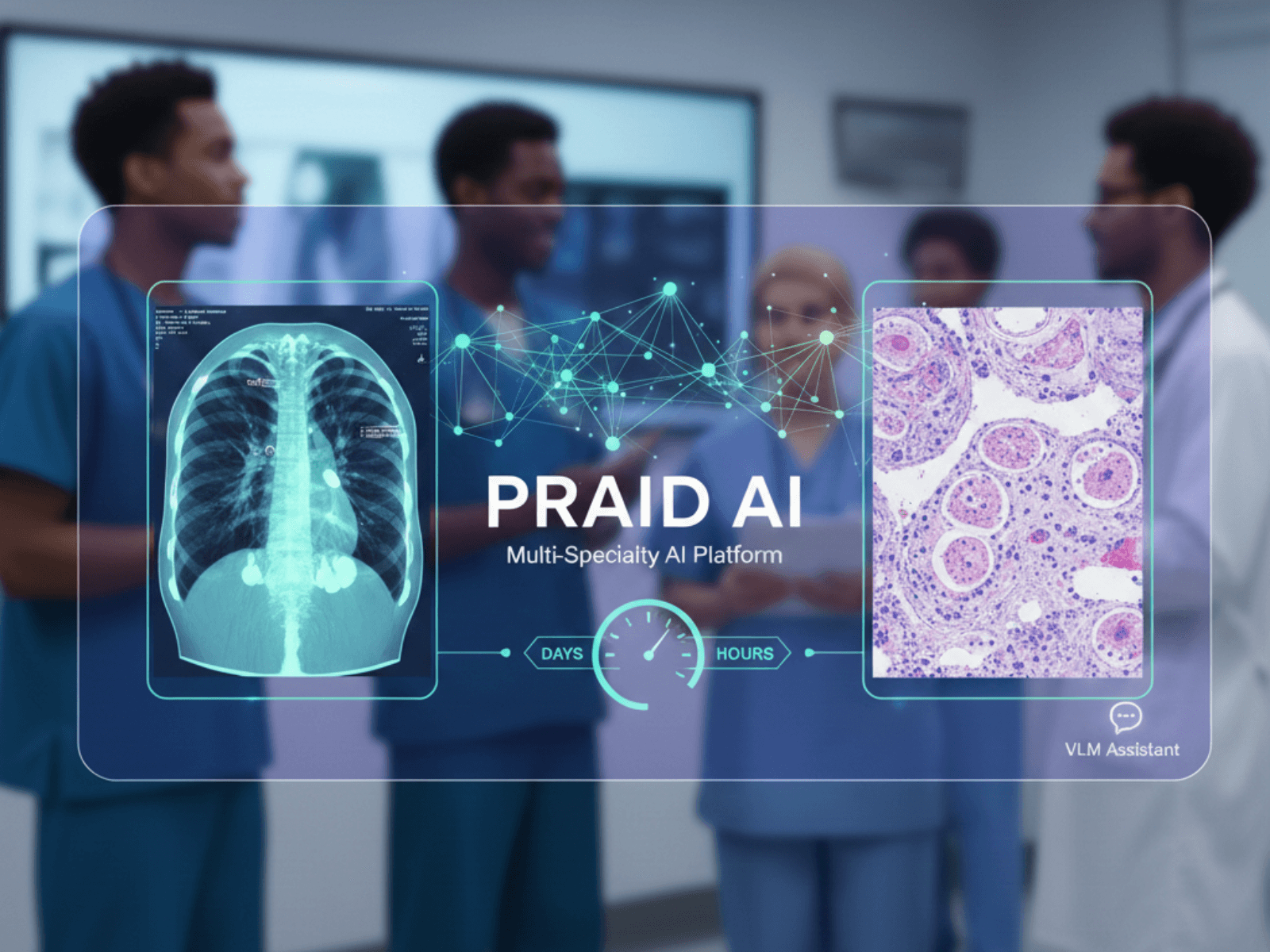
PRAID AI is architecturally designed as a multi-specialty AI platform. It brings together independently trained, best-in-class AI models for radiology and pathology into a single, clinician-friendly interface. PRAID's strength lies in its orchestration layer, a sophisticated platform that deploys, manages, and correlates insights from specialized AI models across the diagnostic journey. The platform provides:- Shared diagnostic context: Suspicious lesions flagged in a CT scan are automatically linked to corresponding histopathology slides within the dashboard.
- Coordinated insights: AI-generated annotations from radiology and pathology are spatially and semantically aligned, presenting a unified picture to the clinician.
- Clinician-in-the-loop workflow: Every AI finding is framed as an assistive insight, requiring human review, validation, and final interpretation. This ensures patient safety, accountability, and compliance with evolving regulations like the EU AI Act.
How PRAID AI Accelerates Diagnosis in Clinics
The acceleration delivered by PRAID AI is systemic, targeting the entire diagnostic chain rather than isolated links:- Reduces handoff delays by 30–50%: By providing a unified patient view that combines imaging and pathology, the platform eliminates the need for back-and-forth calls and emails between departments.
- Speeds correlation of findings: The system's integration logic instantly flags aligned or discordant signals between radiology and pathology AI outputs, turning a manual, hours-long task into a matter of seconds.
- Improves clinical prioritization: Urgent cases are automatically escalated within the dashboard, presented with full, cross-specialty context, enabling faster triage and intervention.
- Lowers cognitive load: By delivering structured, pre-correlated reports, PRAID AI slashes the time clinicians spend on data synthesis and interpretation by up to 40%, allowing them to focus on higher-order decision-making.
Where PRAID AI Fits in the Evolving AI Landscape
PRAID AI occupies a distinct and necessary niche: it is a clinician-centric multi-specialty platform that bridges the gap between deep, specialized AI and holistic clinical workflow. The platform powers radiology-pathology integration for hospitals with:- Specialty-specific AI analysis: Deploying independently validated models for X-rays, CTs, MRIs, and histopathology slides.
- A unified visualization dashboard: A single pane of glass for navigating imaging studies, pathology slides, and correlated AI annotations.
- Structured decision support: AI findings are presented with explainable annotations and linked evidence, fostering trust and understanding.
Including True Multimodal AI: The Vision-Language Model (VLM) Chat
Beyond its core integration engine, PRAID AI incorporates a genuine multimodal AI component, its Vision-Language Model (VLM) chat. This VLM Assistant bridges the critical gap between the structured findings of AI models and natural clinical inquiry. It allows clinicians to interact directly with the scan in front of them using conversational language. For example, a radiologist viewing a complex chest CT can ask the assistant, "Can you highlight and describe the ground-glass opacities in this scan?" or "Explain the clinical significance of this nodule's spiculated margin." The assistant analyzes the same image data alongside its embedded medical knowledge to generate a concise, text-based insight or annotation, effectively translating visual AI outputs into actionable clinical language. This enhances efficiency by providing immediate, context-aware explanations and freeing the clinician from manually searching through reference materials to interpret AI findings.What Clinics Should Prioritize in Diagnostic AI Platforms
When evaluating AI solutions, clinics and hospitals should seek out multi-specialty platforms with demonstrable real-world impact. Key criteria include:- Seamless Workflow Integration: The platform must integrate with existing Hospital IT (PACS, LIS, EMR) without causing disruption or requiring extensive IT projects.
- Comprehensive Multi-Modality Support: Look for support across radiology, pathology, and the flexibility to incorporate future specialties.
- Explainability and Transparency: AI must provide clear, interpretable reasoning for its findings to build clinician trust and facilitate informed decision-making.
- Mandatory Human Oversight: The design must enforce a clinician-in-the-loop paradigm, ensuring AI augments rather than automates critical judgment, which is essential for regulatory compliance and patient safety.
- Measured Impact on Total Turnaround Time: The ultimate metric should be a reduction in the total diagnostic timeline, not just improvements in isolated task speed.
The Future of Faster Diagnosis with AI
The next frontier for AI in healthcare is a decisive shift from pursuing isolated accuracy benchmarks to delivering tangible speed and workflow integration. Multi-specialty platforms are at the forefront of this shift, with major healthcare markets like North America and Asia Pacific leading in adoption and pilot programs. By cutting systemic delays, enhancing clinician trust through transparent design, and focusing on holistic patient pathways, clinician-centric tools like PRAID AI are poised to significantly improve global healthcare outcomes, one faster, more confident diagnosis at a time.References
NHS England: Emergency Department Waiting Times - Source for UK ER wait time statistics.
Start using Praid AI today
- AI-assisted radiology and pathology tools
- Secure, compliant, and easy to integrate
- Manage all your work in one place