
Why Diagnostic Infrastructure Is Breaking And Why PRAID AI Is Building the Operating Layer for the Future
PRAID AI Team · Mar 2, 2026 · Max 14 min read
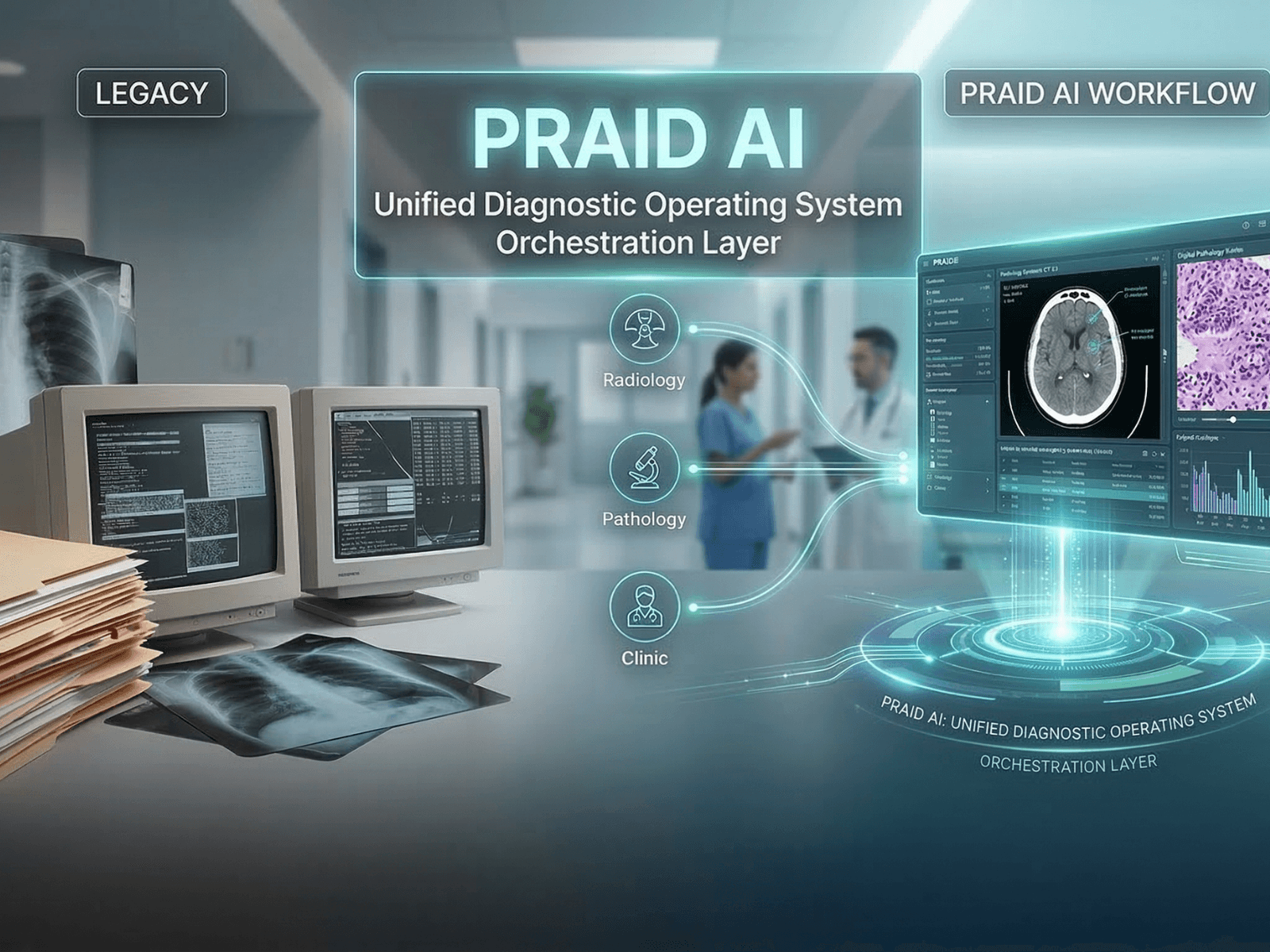
Healthcare is facing a structural inflection point. Radiology departments are overwhelmed with imaging volumes, pathology labs are under increasing pressure from expanding cancer screening programs, turnaround times are stretching, specialists are burning out, and patients are waiting longer for answers that directly determine survival outcomes.
This is not a temporary operational hiccup or a post‑pandemic ripple; rather, it represents a deeper systemic architectural failure within diagnostic infrastructure.
The Diagnostic System Was Never Designed for This Level of Demand
For decades, hospitals were designed around a department‑centric, human‑dependent model of interpretation. PACS, LIS, and RIS systems were revolutionary for their time, but they were built to digitize workflows rather than orchestrate them at AI scale. The infrastructure assumed stable volumes, localized expertise, and predictable linear growth.
Today, diagnostic demand is exponential. Aging populations, increasing oncology prevalence, the rise of chronic diseases, and expanded access to imaging have all compounded the pressure. Meanwhile, the supply of radiologists and pathologists has not scaled at the same pace. The result is a widening capacity gap that incremental hiring alone cannot solve.
The uncomfortable truth is that the diagnostic architecture itself must evolve—and this is precisely where PRAID AI enters the conversation.
Understanding Diagnostic Infrastructure: More Than Just Imaging Machines
Diagnostic infrastructure is often misunderstood as a collection of hardware and software systems such as scanners, microscopes, PACS servers, and reporting tools. In reality, it represents the entire operating ecosystem that transforms raw medical data into actionable clinical decisions.
This ecosystem includes case intake, triage prioritization, specialist assignment, interpretation, structured reporting, validation, compliance tracking, quality monitoring, and revenue cycle integration. When any link in this chain becomes overloaded, the entire system slows down.
Most healthcare systems today still operate on fragmented architectures. Radiology and pathology remain siloed, data is distributed across disconnected systems, and reporting workflows rely heavily on manual routing. Continuous AI validation is often absent or limited to isolated point tools.
This fragmentation is the root cause of structural inefficiency, and it cannot be repaired through isolated AI models alone.
The Evidence: Backlogs, Shortages, and Delays Are Compounding
Research across global health systems confirms rising diagnostic backlogs. Studies have documented significant numbers of unreported radiology examinations in many clinical environments, demonstrating how reporting delays are becoming embedded in routine operations.
The World Health Organization has projected substantial global health workforce shortfalls by 2030, with diagnostic specialists among the most constrained categories. Training pipelines require years of education and cannot accelerate quickly enough to match demand growth.
At the same time, research consistently shows routine discrepancy rates in radiology reporting in the range of 3–5 percent. Under fatigue and overload, error risk increases. Diagnostic strain therefore does not merely delay care—it can also compromise quality.
In oncology, timing is critical. Multiple peer‑reviewed studies indicate that each month of delay in cancer treatment can increase mortality risk. Turnaround time is therefore no longer just an administrative metric; it is a clinical survival variable.
Financially, late‑stage diagnoses impose significantly higher costs than early detection. Delayed interpretation leads to increased treatment expenses, longer hospital stays, and revenue leakage within healthcare systems.
These pressures are not episodic—they are structural.
Why Incremental AI Tools Cannot Solve an Infrastructure Problem
The healthcare industry has embraced artificial intelligence rapidly, and hundreds of AI‑enabled diagnostic devices have received regulatory approval over the past decade. These systems detect lesions, classify abnormalities, and flag suspicious findings with increasing accuracy.
However, most AI implementations remain point solutions. They sit inside existing workflows rather than redesigning them. While they assist interpretation, they do not orchestrate the entire diagnostic lifecycle.
Adding a detection algorithm to a fragmented system does not eliminate backlogs, multiply specialist capacity, unify radiology and pathology data, centralize quality monitoring, or streamline revenue capture.
The true bottleneck in modern diagnostics is not image acquisition but interpretation at scale—and interpretation at scale requires orchestration rather than isolated automation.
PRAID AI: Building the Unified Diagnostic Operating System
PRAID AI was founded on a simple but powerful insight: the core problem in modern diagnostics is not access to imaging, it is interpretation at scale.
Rather than building another isolated AI tool, PRAID AI is constructing a Unified AI‑Powered Diagnostic Operating System. This system acts as a centralized intelligence layer that sits above fragmented hospital systems and transforms diagnostics into scalable infrastructure.
The platform integrates radiology and pathology into a single multimodal AI environment. It includes AI‑generated structured reporting, annotation and validation engines, continuous monitoring and compliance layers, and financial integration components. Instead of functioning as software within a single department, it operates as infrastructure across healthcare networks.
The model shifts diagnostics from hospital‑centric architecture to hub‑centric architecture. Branch sites require only acquisition hardware and upload capability, while intelligence, validation, and reporting occur centrally. In effect, specialist capacity can be multiplied without proportional hiring.
PRAID AI therefore represents more than software, it represents diagnostic infrastructure.
From Hospital‑Centric to Hub‑Centric: The Architectural Evolution
Traditional diagnostic models require each hospital to maintain its own specialist teams and independent workflows. This structure creates redundancy, uneven quality, and limited scalability.
The hub‑based model pioneered by PRAID AI centralizes interpretation while distributing acquisition. Cases flow into a unified AI operating layer where triage, prioritization, validation, and reporting are orchestrated intelligently.
This architecture delivers several advantages: specialist capacity can be multiplied across multiple branches, backlogs can be reduced through intelligent case routing, reporting can be standardized through AI‑generated structured outputs, continuous validation can improve quality and auditability, and revenue capture can improve through integrated workflow monitoring.
Diagnostics therefore becomes software‑defined rather than people‑limited.
Clinical, Operational, and Financial Impact
Infrastructure‑level AI transformation produces measurable outcomes across multiple dimensions.
Clinically, earlier detection improves survival rates and reduces the burden of advanced‑stage disease. Operationally, turnaround times shorten as AI triage and orchestration remove workflow bottlenecks. Financially, hospitals can reduce cost per case while increasing throughput and minimizing revenue leakage.
By embedding AI into the operating layer, PRAID AI enables continuous quality monitoring rather than retrospective auditing. Specialists are augmented rather than replaced, allowing them to focus on complex cases while AI manages repetitive orchestration tasks.
The result is scalable diagnostics without proportional workforce expansion.
Why This Transformation Is Inevitable
Healthcare has already undergone major technological revolutions from paper records to electronic systems and from analog imaging to digital PACS. The next evolution is the transition from fragmented diagnostic workflows to unified AI operating systems.
Demand will continue to rise, specialist supply will remain constrained, regulatory approvals for medical AI are accelerating, and digital imaging is now universal.
What the industry has been missing is the orchestration layer.
Organizations that adopt AI as infrastructure rather than merely as a feature will define the future of scalable diagnostics. PRAID AI is positioning itself not as a tool vendor but as the operating layer for global diagnostic care.
Conclusion: The Future of Diagnostics Is Infrastructure‑Driven
Diagnostic infrastructure is breaking because it was built for a slower, smaller, and more manual world. Incremental tools cannot resolve structural capacity limits; the architecture itself must evolve.
AI must move from assistance to orchestration, from a departmental tool to an infrastructure layer, and from hospital‑centric silos to centralized intelligence hubs.
PRAID AI represents this shift: a Unified Diagnostic Operating System designed to convert diagnostic delay into scalable throughput. The question is no longer whether AI will transform diagnostics—it is who will build the operating layer that enables it at global scale.
Start using Praid AI today
- AI-assisted radiology and pathology tools
- Secure, compliant, and easy to integrate
- Manage all your work in one place